In-house research · NinjaTrader 8 and TradingView
Case Studies
A look at Quantellics strategy research and NinjaScript builds — from New York opening-range breakouts to after-hours Keltner research and tick-based POC models. These are in-house research models, not client engagements. Where a published backtest exists, the figures are labeled as hypothetical and linked to the strategy page.
- Research builds19
- Published backtests2
- PlatformsNinjaTrader 8 · TradingView
How we research a strategy
Idea, rules, historical test
The same path behind every build on this page
Frame the idea
Define the session, the instrument, and the market behavior we want to study.
Write the rules
Encode entries, filters, and exits in NinjaScript — or Pine Script when the research is on TradingView.
Test on history
Review trade frequency, exits, and drawdown on historical data before anything is published.
Simulated research. Past results do not guarantee future results.

quantellics.net
Featured builds
Highlighted case studies
Four highlighted builds, including the two strategies with published hypothetical backtests.
NY Session Breakout Strategy
Capture a clean, rules-based opening-range breakout on Nasdaq-100 futures in the New York regular session, with one trade per day and a hard time exit.
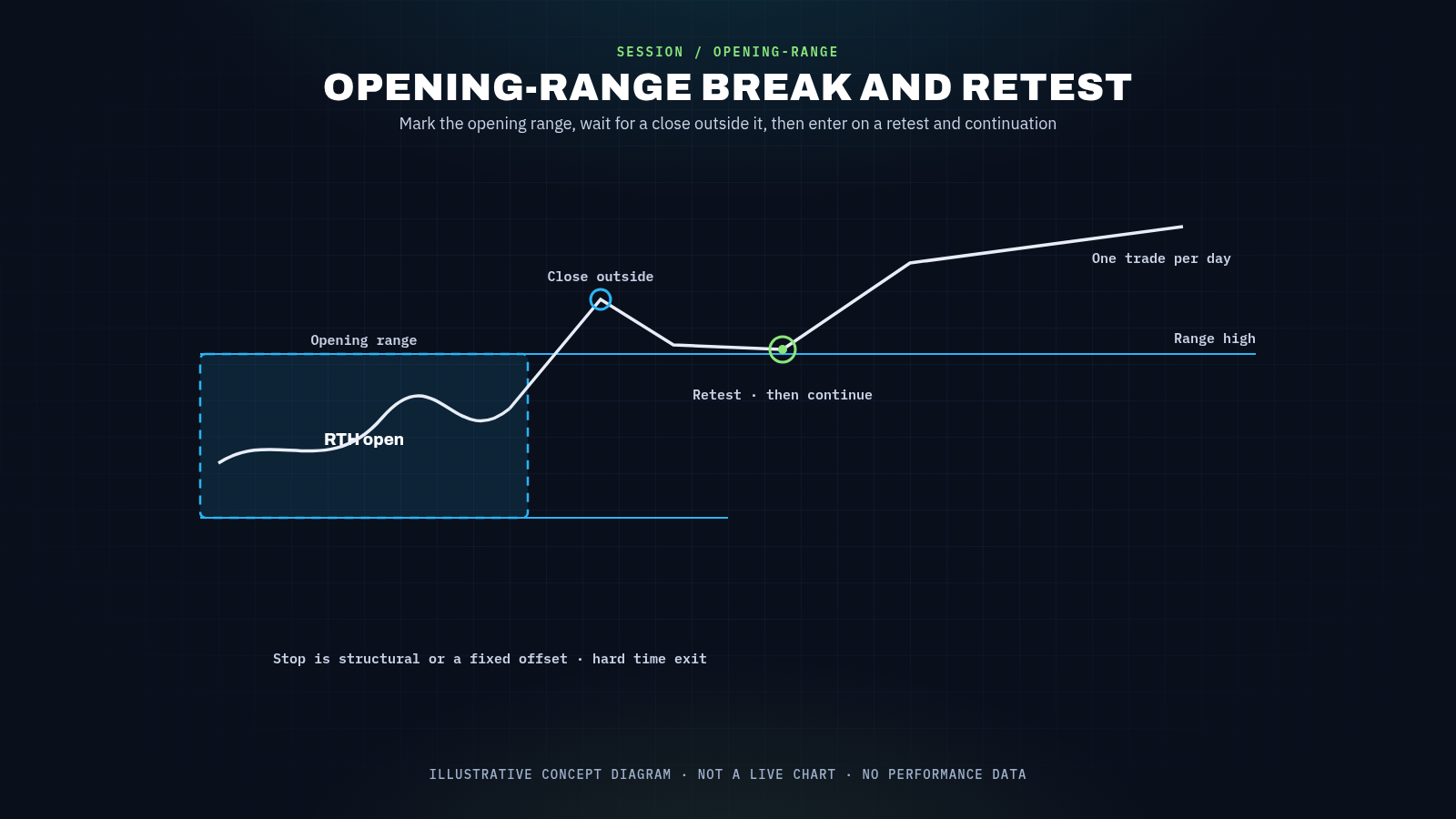
The published model marks the 09:30–09:38 ET opening range, waits for a bar to close outside it, then waits for a retest of the broken level. It enters when price continues in the breakout direction. The stop is structural or a fixed offset, and the trade is held to a stop, a target, or a hard session exit.
Automated NinjaTrader 8 / NinjaScript strategy, published as an in-house Quantellics research page with an interactive dashboard and a downloadable trade dataset.
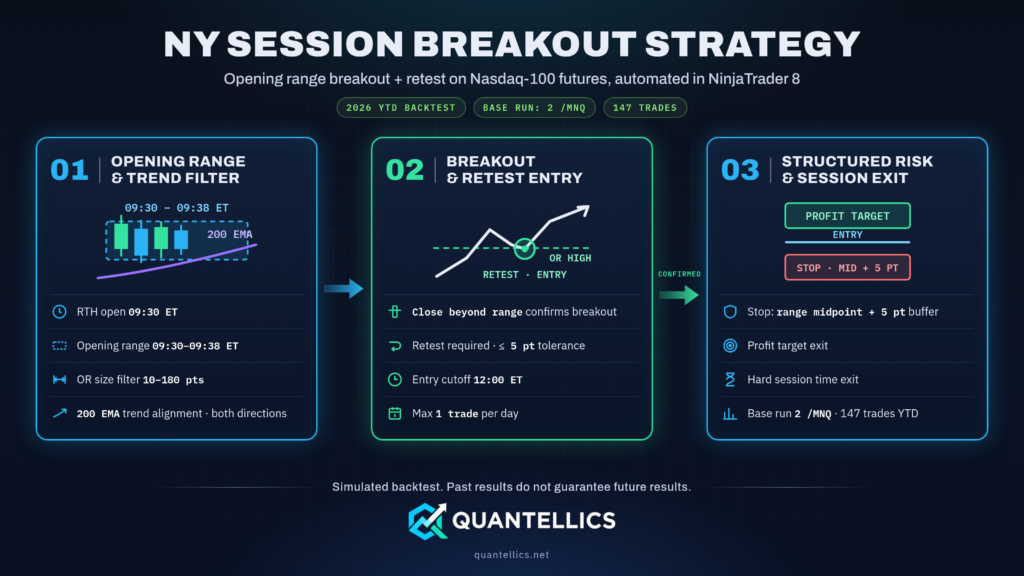
2026 year-to-date hypothetical backtest on 2 /MNQ: 147 trades, $13,599 net. Figures are hypothetical. Open the strategy page for the full dashboard and dataset.
Keltner Channel After Hours Strategy
Follow Keltner-band momentum on MNQ in the quieter after-hours window, with a two-leg entry, per-leg targets, and a hard session flat.
Two closes in a row outside a Keltner band switch the model into bullish or bearish mode. The first entry is at market on the second close, and can be skipped if the channel is too wide. A second entry is added on the first pullback candle. The default window is 19:00–23:00 PT — the period this model performed best in research.
Automated NinjaTrader 8 / NinjaScript strategy (Keltner mode). Published as an in-house Quantellics research page with an interactive dashboard and a downloadable trade dataset.
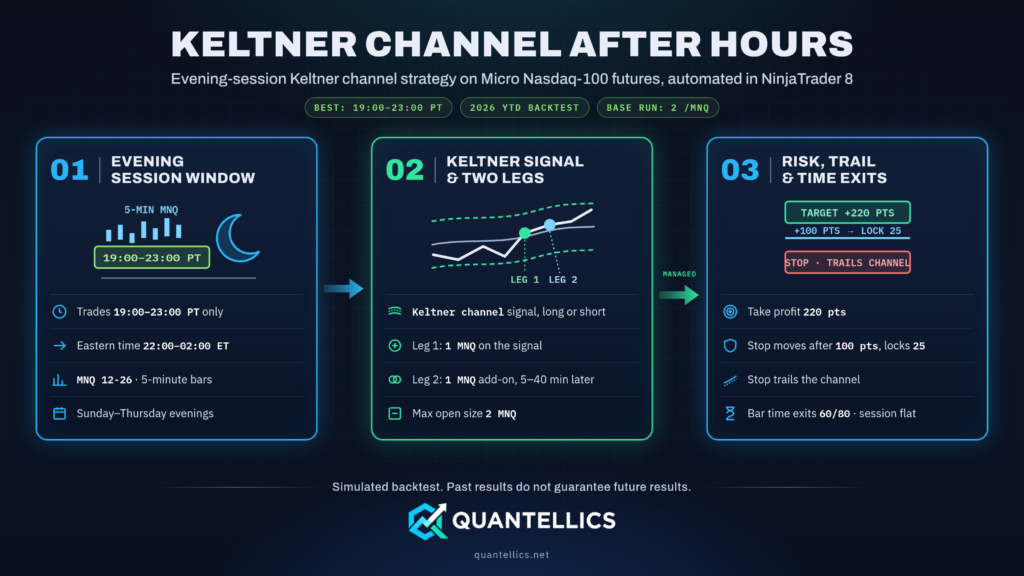
2026 year-to-date hypothetical backtest on 2 /MNQ (two 1-contract legs): 684 trades, $13,467.50 net. Best research window: 19:00–23:00 PT. Figures are hypothetical.
Overnight Range Bias
Form a clear directional bias before the New York open from overnight structure, then take a single, rules-based entry near the open.
The model builds a daily bias from the overnight range and its midpoint, the Asia range, the prior day's levels, liquidity sweeps, and the EMA trend. It enters one trade near the open, at market or after a sweep and reclaim.
In-house NinjaTrader 8 / NinjaScript research. No trade-level dataset is published on this site, so this card does not show performance figures.
In-house overnight-range bias research. No published trade dataset, so no hypothetical backtest figures are shown here.
Prop-firm Evaluation Scalper (MNQ)
Build a compact MNQ model around the constraints of a 50K prop-firm evaluation, with continuation and retest entries in the New York morning and explicit drawdown guards.
It trades 09:35–11:00 ET continuation and retest setups with 15-minute and 3-minute trend alignment, VWAP, and a liquidity sweep and reclaim. It takes up to 2 MNQ, with a structural stop of 50–100 points and split targets at 200 and 300 points, plus daily, weekly, and drawdown guards.
In-house NinjaScript research iterated across four versions. Later versions make the filters ATR-based, require trend alignment, and skip setups whose structural stop is too tight. No trade dataset is published, so no performance figures are shown.
Variants The research line runs through four versions. Later versions tighten filters from the research logs, require trend alignment, and skip setups whose structural stop is too tight.
Four iterative NinjaScript versions are on file as in-house research. No public backtest figures are published.
Figures shown for the NY Session Breakout and Keltner Channel After Hours strategies are hypothetical backtests. Read the CFTC hypothetical performance disclosure.
All builds
Strategy research library
Filter the library by research family. Performance figures appear only on the two strategies with a published dataset.
Showing all 19 case studies.
NY Session Breakout Strategy
Builds the New York opening range (09:30–09:38 ET on the published page), waits for a close outside it, then enters on a retest and continuation — one trade per day. The stop is structural or a fixed offset, and the trade is held to a stop, a target, or a hard time exit.
Keltner Channel After Hours Strategy
A trend-following Keltner model: two closes in a row outside a band switch it into bullish or bearish mode. The first entry is at market on the second close — and can be skipped if the channel is too wide — and a second entry is added on the first pullback candle. Per-leg targets, time exits, and a session flat, in a default 19:00–23:00 PT window.
Overnight Range Bias
An in-house strategy that forms a daily bias before the New York open from the overnight range and its midpoint, the Asia range, the prior day's levels, liquidity sweeps, and the EMA trend. It enters one trade near the open, at market or after a sweep and reclaim. The only exits are the stop and a 13:55 ET time exit.
Prop-firm Evaluation Scalper (MNQ)
Built around the constraints of a 50K prop-firm evaluation. It trades New York morning (09:35–11:00 ET) continuation and retest setups with 15-minute and 3-minute trend alignment, VWAP, and a liquidity sweep and reclaim. It takes up to 2 MNQ, with a structural stop of 50–100 points, split targets at 200 and 300 points, and daily, weekly, and drawdown guards.
Variants The research line runs through four versions. Later versions tighten filters from the research logs, require trend alignment, and skip setups whose structural stop is too tight.
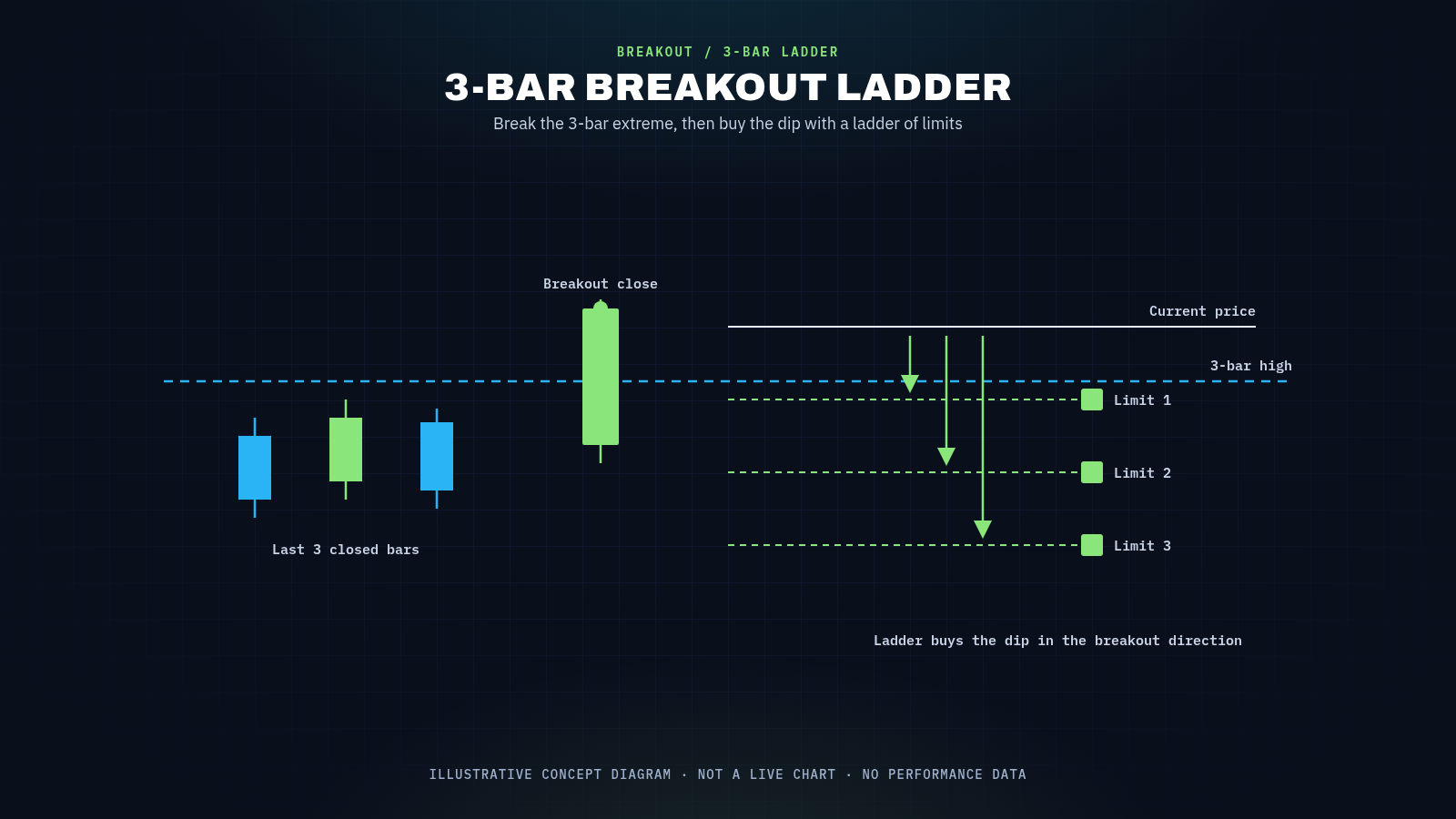
3-bar Ladder Scalper
When NQ breaks the high or low of the last three closed bars, the strategy places a ladder of limit orders behind the market to buy the dip in the breakout direction. Exits are a short target from the average fill and a wider stop, with morning and afternoon windows, daily profit and loss limits, and a cap on losses in a row.
Variants Variants include a 5-point target with entries 5, 10 and 15 points back; a 10-point target that also exits if the 3-bar extreme is reversed; a hard-stop version with an exit buffer; and the same hard stop with ADX, ATR and 50-EMA regime filters.
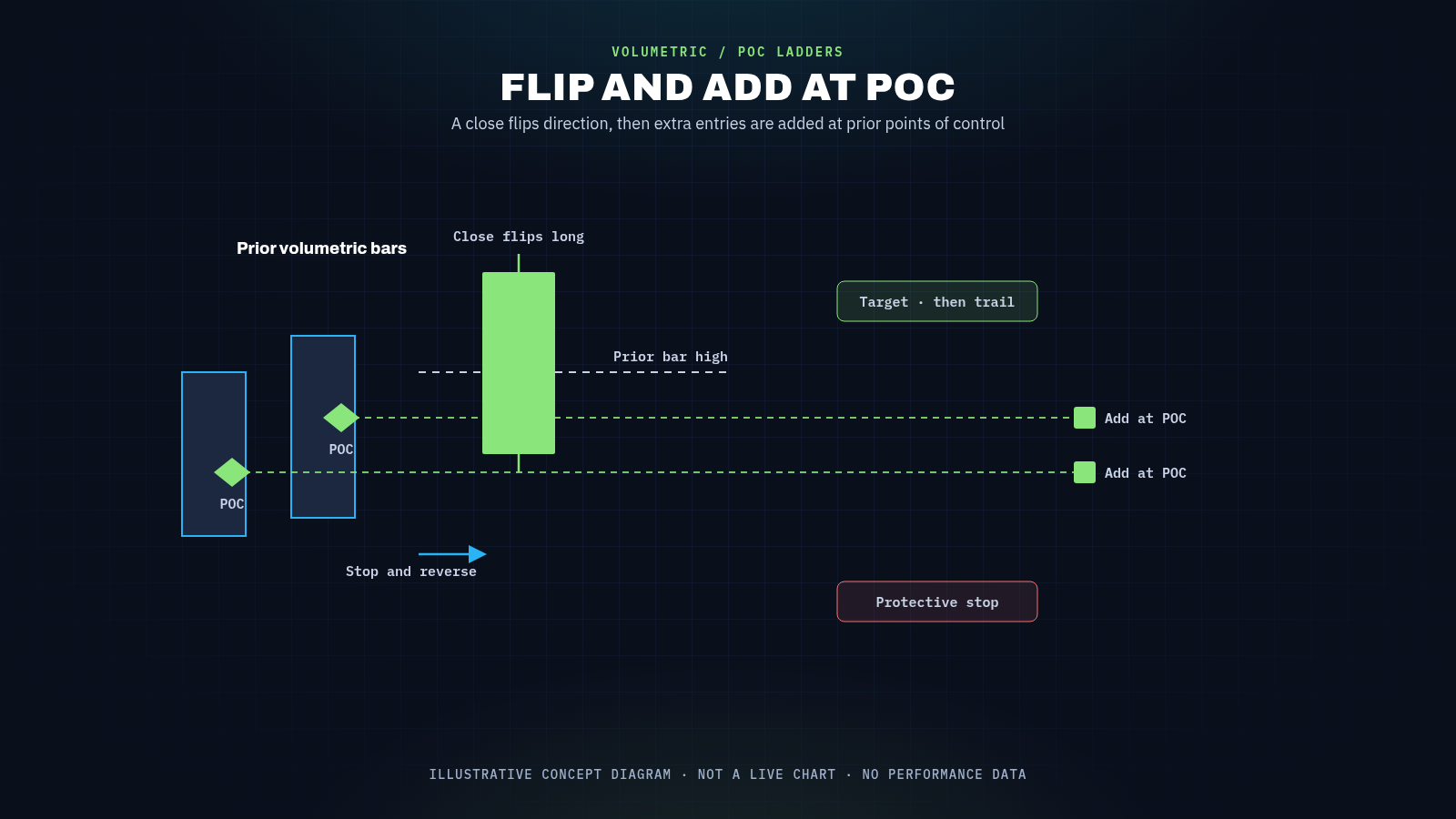
NQ Volumetric POC Ladder
A stop-and-reverse model: a close beyond the prior bar's high or low flips the direction, then two more entries are added as limit orders at the point of control of the previous two volumetric bars. The target is 7 points with a 30-point stop, and the stop moves to lock profit after 5 points.
Variants One version flips on a single close beyond the prior bar. A second version waits for two bars of higher highs or lower lows, and only adds at a POC that sits on the pullback side of the bar.
POC Scalper
Watches the point of control of the bar that is still forming. Once enough volume has traded at that POC and the bar is trending — a higher high and higher low, or the reverse — it places three limit orders beyond the POC to buy the pullback. Target and stop are set from the average fill.
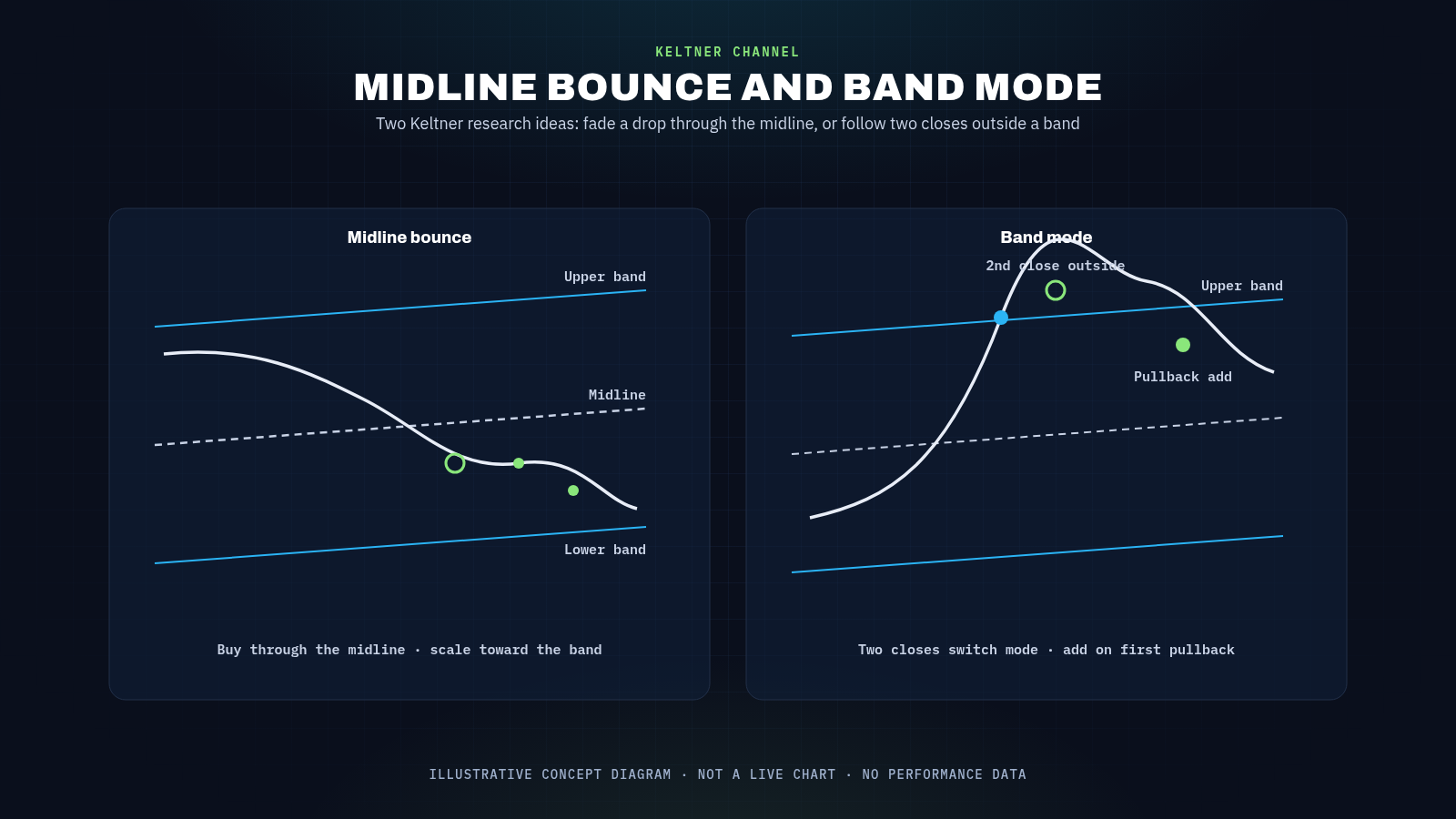
NQ Keltner Bounce
A mean-reversion bounce on NQ. When price was above the Keltner midline two bars ago and has now dropped below the midline but is still above the lower band, it buys at market and scales in with limit orders toward the lower band; shorts are the mirror image. The target is the opposite band, with a trailing stop, and trading halts for the day if the model gives back half of a strong day's peak profit.
Variants A second version adds a DEMA trend filter, so it only buys above the DEMA and only sells below it.
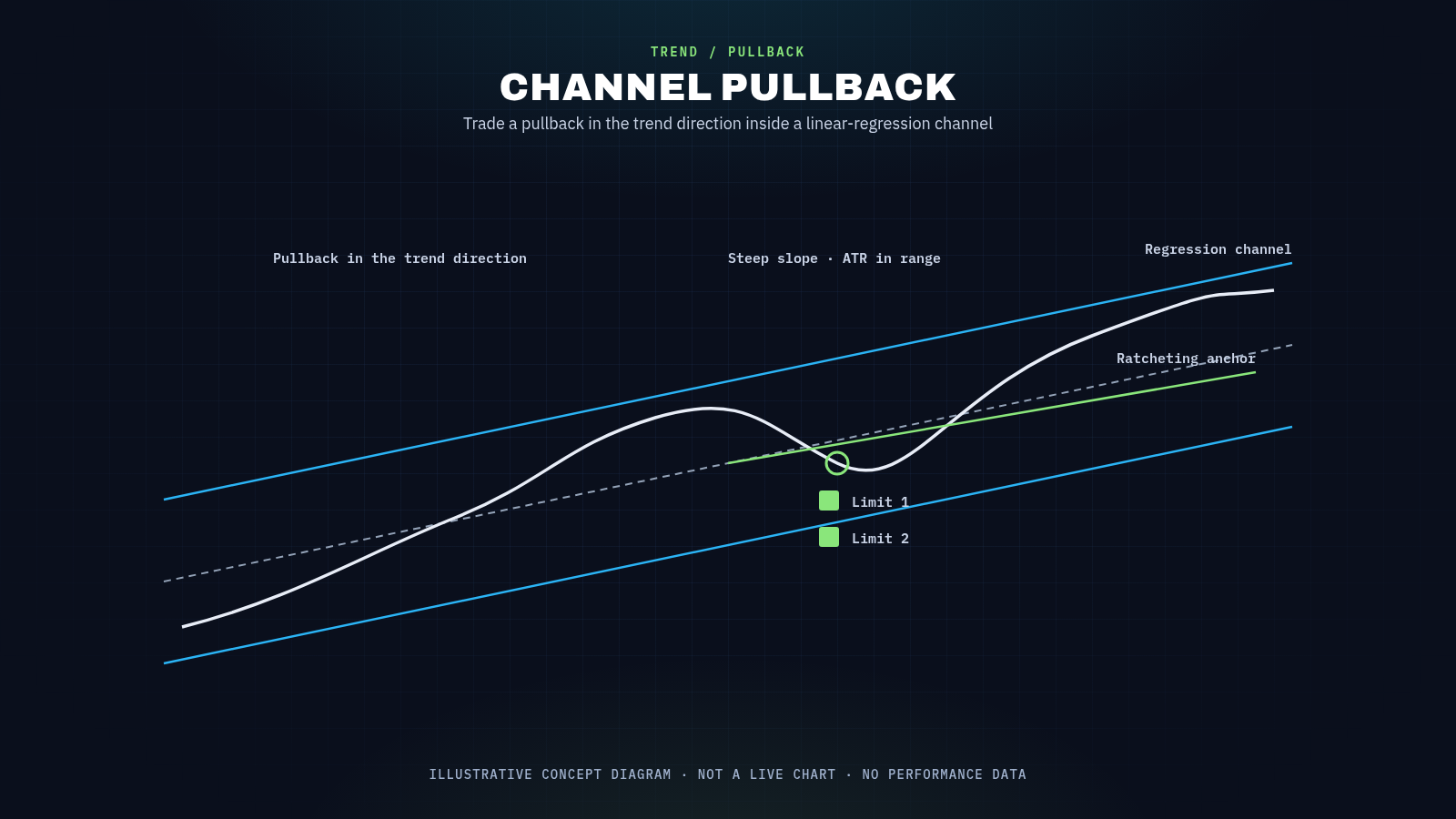
NQ Channel Retrace Scalper
Trades pullbacks in the trend direction inside a linear-regression channel on NQ, only when the slope is steep enough and ATR is in range. Two limit orders sit below an anchor that only ratchets in the trend direction — the highest low so far for longs — and a trailing stop starts once the trade is in profit.
Pullback to Last High
When the last bar was trending — a higher high and higher low, or the reverse — it enters on a break of that bar's high or low, and can add a second entry if price pulls back 12 points from that level. Stop and target cover the whole position, with optional RSI and bar-size filters and prop-firm style risk controls.
Return to DEMA
When a candle crosses a double exponential moving average, with optional close-side confirmation, it places three limit orders spaced by ATR. Exits are a tick-driven target and stop, plus a ratcheting trailing stop.
MACD Crossover Strategy
Trades MACD and signal-line crosses only at extremes: a bullish cross must occur with MACD below −20, and a bearish cross with MACD above +20. It takes half off at the first target and the rest at the second, moves the stop to breakeven, uses two time-stops, and can exit on an opposite cross.
GG Scalp
Every bar it places a buy stop and a sell stop a set ATR multiple from the close; whichever fills becomes the trade. The exit is an ATR trailing stop, and it stands aside when ATR is low.
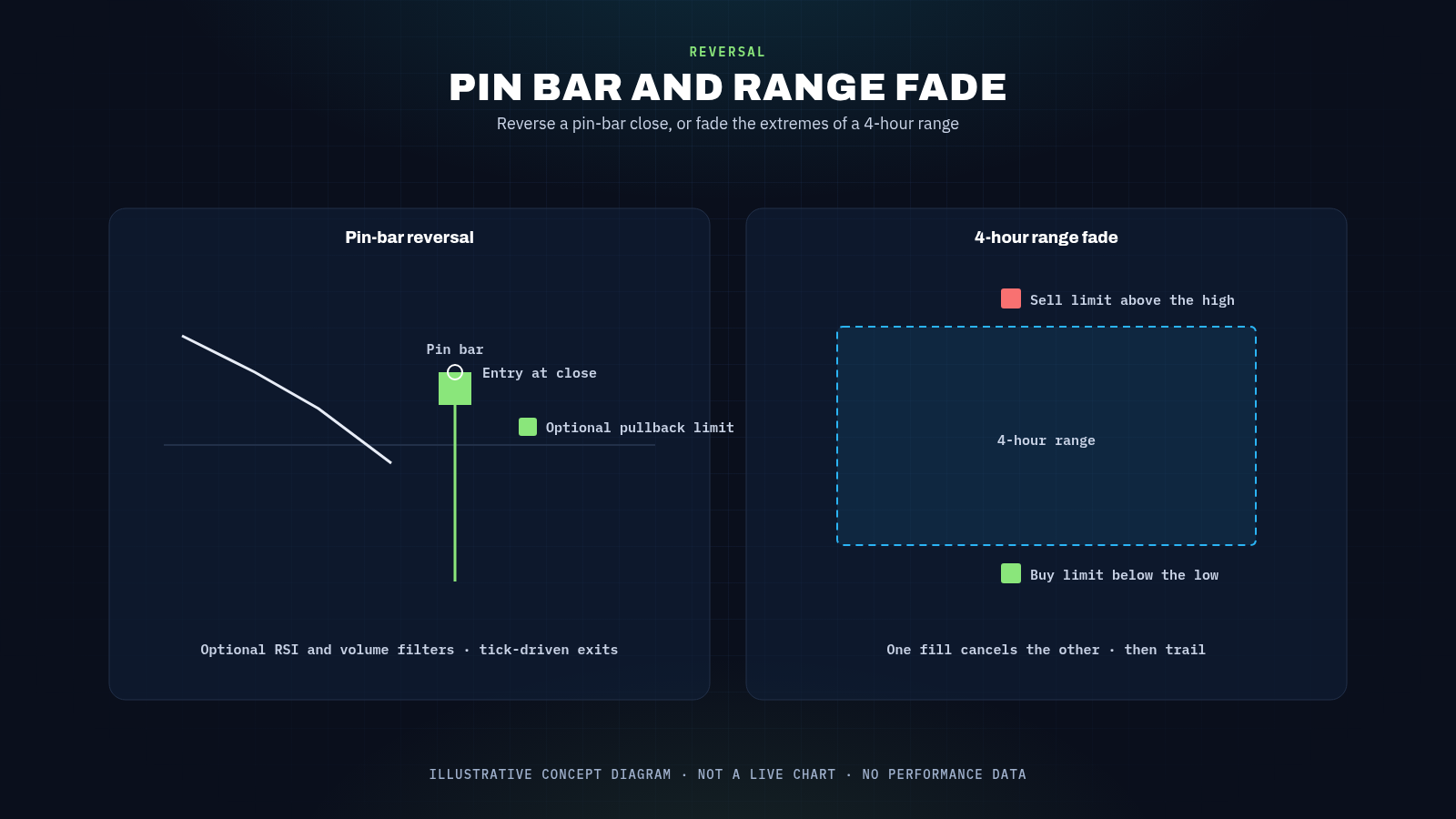
Pin Bar Strategy
A pin-bar reversal: the first entry is at market on the signal bar's close, with an optional second entry as a pullback limit. Optional RSI and volume filters can apply, and exits are tick-driven, with a daily-risk halt.
Variants A second version runs the same logic without the volume filter.
Four-Hour Extremes Strategy
Fades the 4-hour range. It places a buy limit 10 points below the 4-hour low and a sell limit 10 points above the 4-hour high; when one fills, the other is cancelled. Target is 50 points and the stop is 30, with a breakeven move at +30 and then a trailing stop. It flattens at 13:45 and stops for the day after two losing trades.

NQ Reverse From EMA
A session-based NQ reversal study on TradingView: snap-backs toward an EMA after an intraday stretch, limited to a New York morning window, with a fixed stop and target and an optional delayed trailing stop. No trade-level dataset is published on this site, so no performance figures are shown.
POC Long
A long-only model on a 3-minute MNQ chart, using a point of control built from tick data. Rule A buys when the POC sits in the lower half of the prior bar; Rule B buys when the POC is above the prior bar's high. Entries are taken from 07:00 to 12:00 PT.
POC Strategy
Bias comes from the last close versus the Keltner midline. When price breaks the prior bar's high or low, it places a limit order at whichever recent bar's POC is closest to the midline. The stop moves to breakeven, then locks profit at a set fraction of the target.
POC Sweep Strategy
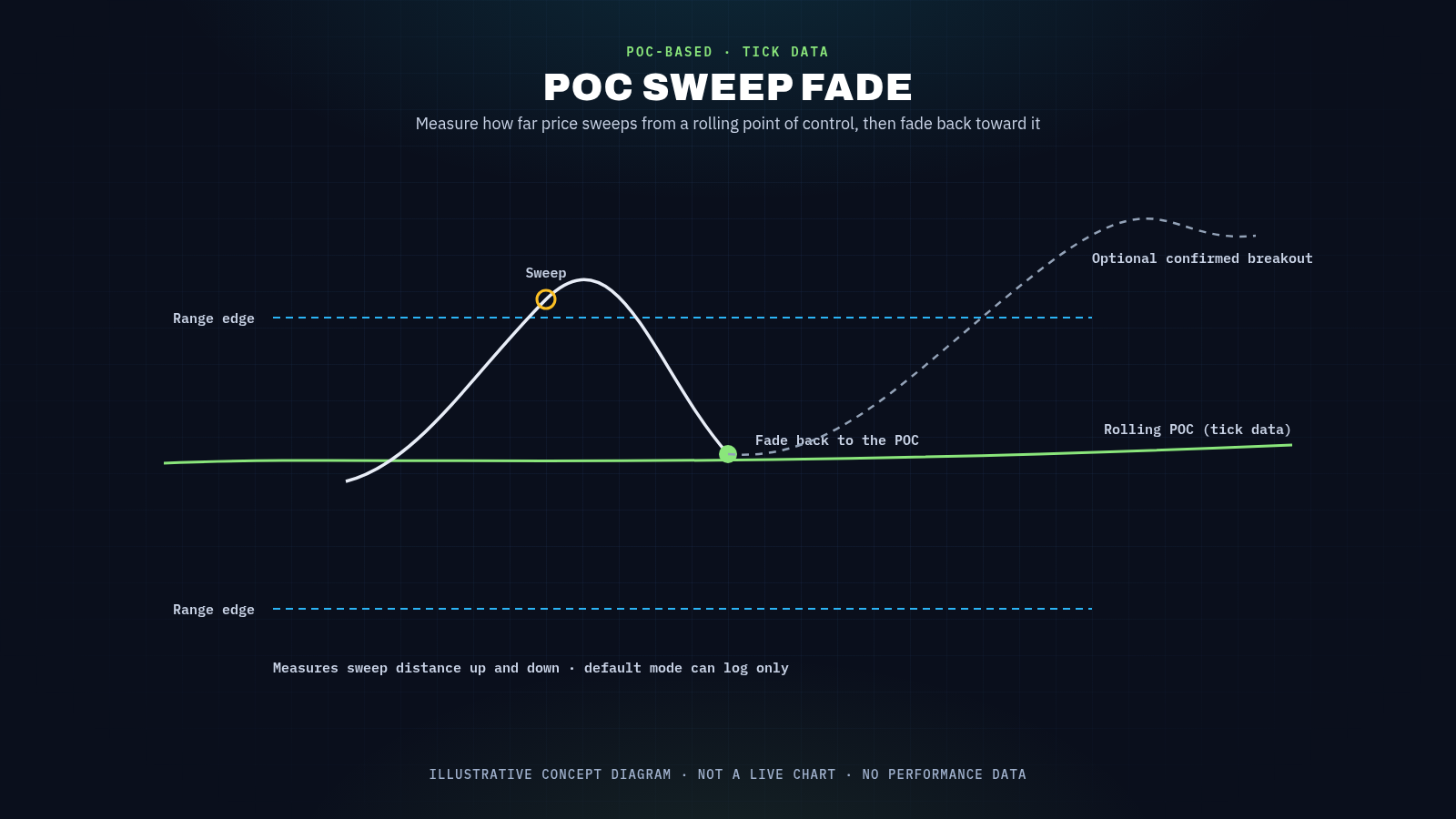
Measures how far price strays from a rolling tick-based POC — sweeps — and how often it comes back, keeping separate statistics for up and down. Once a range is established, it can fade the nearer edge, about the median sweep distance, with the POC as the target, or switch to a confirmed breakout when a bar closes beyond the outer edge with matching delta and volume. The default mode only measures and logs, without placing orders.
No case studies in this category.
Custom development
Have a strategy idea?
If you have a strategy, indicator, or add-on you want built or tested in NinjaTrader, tell us about it on the custom development page, or reach us through the contact form.