Prop Firms
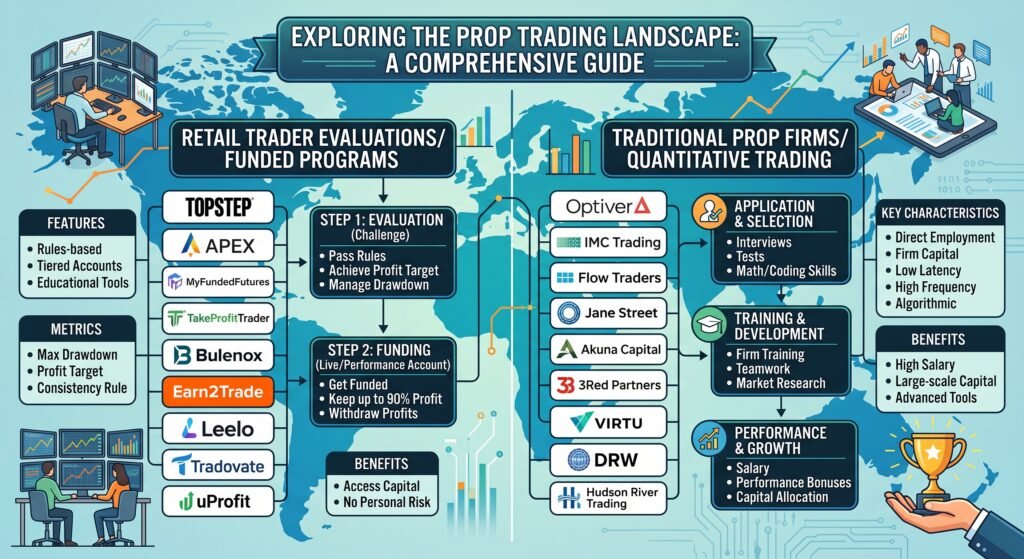
Most traders evaluate prop firms the way they evaluate a broker: account sizes, fees, profit split. Then they fail an evaluation and discover the thing that actually mattered was a sentence in the rulebook they never read.
A prop firm is not selling you capital. It is selling you a rule set. The capital is simulated until you earn a payout, and whether you ever get there depends almost entirely on how the rules interact with how you already trade. Two firms with identical account sizes, identical targets, and identical prices can be completely different products because of one variable.
How the arrangement actually works
A proprietary trading firm gives you access to capital in exchange for a share of the profits you produce with it. You do not deposit trading capital and you are not risking your own money in the market. What you pay for is the evaluation.
The path has two stages. You buy an evaluation account and trade it in a simulated environment, aiming to reach a profit target without breaching the drawdown limit or any of the firm’s other rules. Requirements differ by firm: some impose a minimum number of trading days, some restrict overnight positions, some cap daily losses.
Pass, and you move to a funded or performance account, which typically starts at the same nominal balance as the evaluation. Meet the payout criteria there and you can withdraw a share of the profit.
Evaluation account sizes generally run from around $25,000 to $300,000. Each size carries its own profit target, its own drawdown allowance, and its own limit on how many accounts you may trade.
Worth understanding the business model plainly: most traders do not pass. Evaluation and activation fees are the primary revenue source for most firms. That does not make them predatory, but it does mean their income does not depend on your success.
Drawdown mechanics decide almost everything
Every futures prop firm gives you a loss floor. The difference is when that floor moves, and that single distinction separates traders who pass from traders who keep buying resets.
Intraday trailing drawdown tracks your peak balance in real time, including unrealized profit. If you are up $1,200 at 10:15 and give it back by 11:00, your floor moved up with the peak and stayed there. You never banked that money, but you permanently lost that much room. For anyone who lets winners run and gives back part of the move, this is brutal. It punishes the exact behavior most trend strategies require.
End-of-day trailing drawdown recalculates once, at the close. Intraday heat costs you nothing as long as you finish the session above the floor. Same account size, same target, radically different experience if your strategy breathes.
Static drawdown never moves. The floor sits where it started. Simplest to reason about, generally the most forgiving once you are profitable, and increasingly rare.
If you take one thing from this: match the drawdown type to your holding behavior before you compare anything else. A scalper who exits flat or better most sessions can survive intraday trailing. A trader who scales out of runners cannot, and no amount of discipline will change the arithmetic.
Check the connection type before you pay
This is the detail that catches people after the purchase, and it has nothing to do with trading rules.
Prop firms route order flow through Rithmic or Tradovate, and some offer a choice. The distinction matters if you intend to run more than one funded account at a time, because NinjaTrader Desktop supports only one Rithmic data feed connection per installation. Tradovate does not carry that restriction.
The practical consequence: a trader holding three Rithmic-based evaluations from three different firms cannot simply connect all three in one NinjaTrader instance. Anyone planning a multi-account approach should confirm the connection type before buying the evaluation, not after.
Verify this against your firm’s current documentation and NinjaTrader’s own. Platform behavior and firm arrangements both change.
Consistency rules are the quiet account killer
Most firms cap how much of your total profit can come from a single day. Clear one big day and the rest of your qualifying days look thin by comparison, and suddenly the payout you earned is not payable yet.
This rule catches good traders more often than bad ones. A bad trader never gets close. A good trader has one exceptional session, then finds that the session is the reason they cannot withdraw. The consistency percentage varies by firm, and several firms have tightened theirs during 2025 and 2026.
The practical consequence is that once you are funded, your job changes. You are no longer maximizing profit. You are producing a profit distribution that satisfies a formula. Those are different objectives and they require different position sizing.
The real cost is the retry loop
Headline evaluation prices are close to meaningless, because they assume you pass on the first attempt. Industry pass rates for futures evaluations are commonly cited in the single digits to low teens.
Run the math on the realistic case instead of the advertised one. Take the evaluation fee, multiply by the number of attempts you honestly expect, add any activation or reset fees, add the monthly cost of data and platform. Then compare that number against firms. The cheapest headline price is frequently not the cheapest path to a funded account, and a firm with a higher entry price and a more forgiving drawdown can work out cheaper across three attempts.
Rules change, and they change often
The 2026 landscape looks materially different from 2025. Major firms have restructured pricing models, changed drawdown options, revised consistency thresholds, adjusted payout ladders, and altered what is permitted around overnight positions and automation. Several made multiple rule changes inside a single year.
Two implications. First, any comparison article, including this one, has a shelf life measured in weeks. Verify current rules on the firm’s own help center before you pay for anything. Second, treat rule stability itself as a selection criterion. A firm that rewrites its terms three times a year is a firm whose economics you cannot plan around, however attractive today’s terms look.
Pay particular attention to rules governing automation. Firms differ on whether bots and automated strategies are allowed, and several permit them during evaluation while restricting them on funded accounts. If your process depends on automation, this is a pass/fail criterion, not a detail.
What actually moves the needle
Once you have picked a firm whose drawdown mechanics fit your strategy, the remaining variables are all about execution quality.
Enforce your risk limits mechanically. The rules that end funded accounts are quantitative: a daily loss number, a trailing floor, a position size cap. Quantitative rules should be enforced by software, not by willpower at the moment you are down and want it back. Discipline is least available exactly when it matters most.
Know your distribution, not just your P&L. Consistency rules mean the shape of your results determines whether you get paid. That requires tracking per-day contribution against your running total, which is not something most traders do in their head.
Be deliberate about multiple accounts. Running several evaluations at once is a legitimate way to diversify the variance of a low pass rate. It also multiplies your execution workload and your opportunity for manual error. Mirroring orders across accounts reliably matters more as the count rises, and mirroring at the order level, so protective stops arrive with the entry rather than after it, is the difference between a hedged approach and a correlated blow-up.
Review the losing days properly. Most rule breaches are behavioral and repeat. The same hour, the same instrument, the same escalation after the same kind of loss. Patterns like that are visible in the trade record and almost invisible from memory.
The honest summary
Prop firms are a legitimate route to trading size you could not otherwise access, and they are also a business that profits from evaluation fees. Both things are true simultaneously. The firms are not adversaries, but their revenue model does not require you to succeed.
Approach it accordingly. Read the rulebook before the marketing page. Model the cost of three attempts, not one. Pick the drawdown structure that matches how you already trade rather than the one you wish you traded. Confirm the connection type supports the number of accounts you intend to run. And automate the constraints that end accounts, because the moment you need them is the moment you will not apply them yourself.
Quantellics builds NinjaTrader and TradingView tools for futures traders, including account risk tools and a multi-account trade copier used by traders running funded evaluations alongside personal accounts.
Quantellics is not affiliated with, endorsed by, or sponsored by NinjaTrader, Rithmic, Tradovate, or any proprietary trading firm referenced or implied here. Your firm’s and broker’s own terms govern how you may use your account.
Rule details described here reflect the general landscape as of September 2026 and are not specific to any one firm. Prop firm terms change frequently. Always verify current rules directly with the firm before purchasing an evaluation.
Risk disclosure: Futures trading involves substantial risk of loss and is not suitable for every investor. Only risk capital you can afford to lose should be used. Past performance is not necessarily indicative of future results. Nothing here is investment advice.
CFTC Rule 4.41(b)(1)(i): Simulated or hypothetical trading results have certain limitations and are an unreliable predictor of future performance. Unlike an actual performance record, simulated results do not represent actual trading and may not reflect the impact of human error, liquidity, and other market conditions. Prop firm evaluation accounts are simulated trading environments.