Futures Risk Disclosures
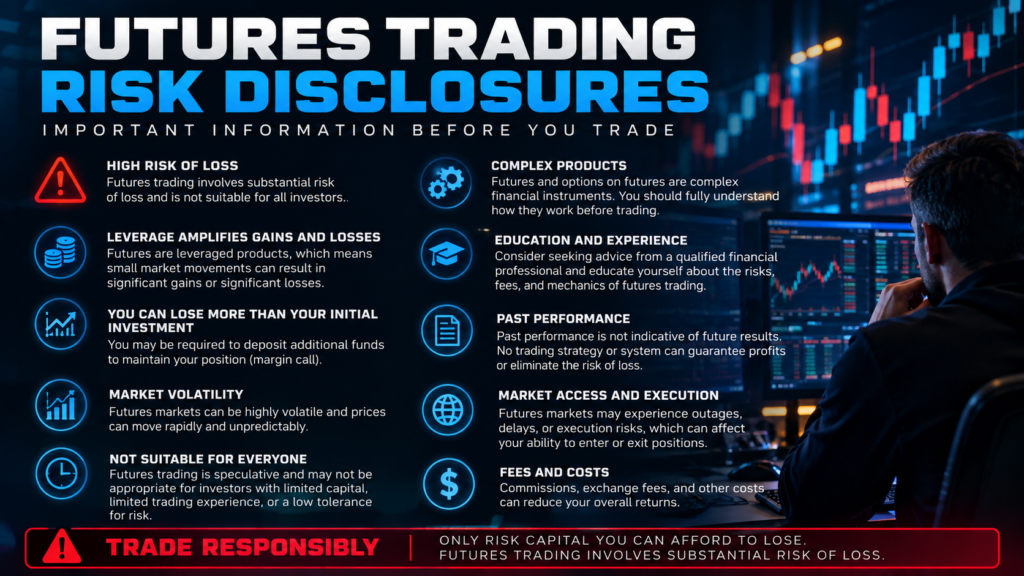
Futures trading involves substantial risk and is not suitable for everyone. You can lose your entire deposit and may owe additional money beyond the funds placed in your account.
Understanding these risks is essential before using any trading strategy, indicator, automated system, or futures brokerage account. This overview is educational and does not replace your broker’s risk disclosures or account agreement.
Leverage and margin calls
A futures margin deposit supports a contract with a much larger market exposure. Leverage magnifies both gains and losses. A small adverse price move can therefore cause a large loss relative to your deposit.
You may need to deposit additional funds on short notice. If you cannot meet margin requirements, your broker may liquidate positions, and you remain responsible for any account deficit. Review your broker’s liquidation policy and margin requirements before trading. See the CFTC’s guide to contractual obligations.
Market conditions and order execution
Fast markets, low liquidity, price limits, and trading interruptions can make it difficult to close a position. Stop orders do not guarantee an exit at the requested price; stop-limit orders may not execute at all. Slippage and transaction costs can increase losses or reduce profits.
Internet outages, delayed market data, platform failures, and automation errors can also disrupt trading. Monitor open positions and understand your broker’s alternative procedures for placing or cancelling orders.
Contract specifications and expiration
Before entering a trade, understand the contract size, tick value, trading hours, expiration date, and settlement method. Some contracts involve physical delivery; others settle in cash. Holding a position near expiration may create obligations you did not intend to assume. The CFTC’s futures trading overview explains these basics and the importance of reviewing broker disclosures.
Past performance and simulated results
Past performance does not guarantee future results. Backtests, paper trading, and other hypothetical results are not actual trading records. They may benefit from hindsight and may not accurately reflect liquidity, slippage, costs, or the difficulty of following a strategy while losing real money.
Indicators and automated strategies cannot eliminate market risk. Treat simulated results as research inputs, not promises of future returns. For more detail, see NFA guidance on hypothetical performance.
Before you trade
Assess your financial resources, experience, and ability to absorb losses. Use only risk capital whose loss would not compromise essential expenses or long-term obligations. Read the account agreement, fee schedule, and all product-specific disclosures, and ask your broker to explain anything unclear.
This article provides general information, not personalized investment, legal, or tax advice or a recommendation to buy or sell any contract. It cannot describe every risk and does not substitute for disclosures required for a particular product or service.